

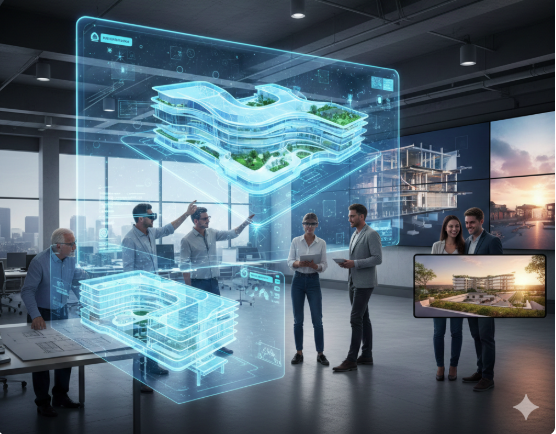
One of the greatest problems in architecture is design communication. It is not always simple to translate complex ideas into forms that can be easily understood by clients, consultants, and other stakeholders. There is always a possibility of interpretation of technical drawings and plans, thus confusion and revisions. It is here that 3D architectural visualization has a transformational role to play.
It facilitates access to the communication of design by transforming abstract ideas into perceptual and lifelike images, thus closing the gap between imagination and comprehension, making the process of design communication more accessible and inclusive.
Visualizing Technical Concepts
The layers of architectural designs are scale, materials, lighting, and spatial relationships. These aspects cannot be expressed using 2D drawings only.
The architectural visualization through 3D technology will convert the technical data into visual narratives that can be interpreted by every individual. Designers do not have to describe how a space would feel, but can do it at a glance.
Some of the most important communication aspects are:
- Good depiction of design intent.
- Non-technical audiences can read and understand it easily.
- Less reliance on explanations of technicality.
Increasing Client Knowledge and Trust
Clients usually have problems imagining the results at the initial steps of design. This hesitation has the potential to postpone making decisions and approvals.
The 3D architectural visualization gives the customers a chance to have real scenarios of the projects even before the construction starts. This transparency creates confidence and trust in the design process. The services of professional 3D modeling are used to make sure that these pictures are as accurate and emotionally impactful as possible.
The benefits to the clients are:
- Better expressiveness of layouts and proportions.
- Quick and more assured approvals.
- More powerful relationships between clients and designers.
Enhancing Teamwork Among Design Teams
There are various disciplines engaged in architectural projects. The architects, engineers, and contractors may fail to work together due to a costly breakdown in communication.
The visualization of architecture in 3D generates a common visual language that unites everybody to the same understanding. Combined with professional 3D modeling services, it makes sure that the design is understood by all the stakeholders.
The advantages of collaboration are:
- Reduced team-to-team misunderstandings.
- Easy visualization of design change.
- Better coordination of disciplines.
Communicating Scale, Space, and Proportion Clearly
The scale and proportion are commonly misunderstood in drawing and plans. Even seasoned stakeholders might be unable to imagine how spaces will feel in real life.
In 3D architecture visualization, the designers convey spatial relationships intuitively and in an accurate manner. The viewers are able to understand at first the size of rooms, ceiling height, and circulation flow.
Spatial clarity improves:
- Knowledge of dimensions of the real world.
- Openness and comfort perceptions.
- Early spatial problem identification.
Encouraging Design Feedback and Design Iteration
The best feedback is the one that is founded on mutual understanding. Abusive images tend to lead to ambiguous or delayed reactions.
The realistic visualization of the project and walkthrough allows the architect to provide actionable feedback, and the 3D modeling service provides the architect with an opportunity to update the visuals fast, keeping communication transparent during revisions.
It has been improved in terms of feedback:
- More specific client input
- Faster iteration cycles
- Less reworking in the later stages.
Strengthening Presentations and Approvals
It is not only an architectural presentation of beauty, but it also comes down to persuasion and clarity.
A good 3D architectural view allows the visualization of ideas to be made tangible. Designs become easily assessed, and decision-makers have an easy time approving the design. These images can be effective instruments of decision-making when reinforced by professional 3D modeling services.
The benefits of presentations are:
- Visually appealing proposals.
- Better stakeholder participation.
- Increased success rates of approvals.
Overcoming Culture and Language Bias
Global teams and clients are usually involved in design projects. Communication may be complicated by language differences.
The visual representation is not language-specific. 3D architectural visualization is the means of conveying ideas in a universal way, which minimizes the chances of misunderstanding in different cultures and places.
The advantages of cross-cultural communication are:
- Effective communication that does not require lots of explanation.
- Uniformity in multi-national work-groups.
- Less reliance on the translations.
Conclusion
3D architectural visualization is now a fundamental means of communication in the architectural world today. It enhances comprehension, coordination, and decision-making in all phases of a project by simplifying complex concepts into realistic graphics.
Combined with 3D modeling by the professional, architectural visualization not only demonstrates some designs, but also puts people together, builds confidence, and makes sure that the intent of the design is conveyed effectively and clearly throughout the course of the design.